
With momentum building around the IPO, the NSE saw a surge in retail investors in the last two years, making it one of the widely traded stocks in the unlisted market.

Amrita Singh Tomar, a woman tehsildar known for her appearance on 'Kaun Banega Crorepati', has been arrested in connection with a Rs 2.5 crore flood relief scam in Madhya Pradesh.

Amita Singh Tomar, a woman tehsildar who gained fame on 'Kaun Banega Crorepati', has been arrested for her alleged involvement in a Rs 2.5 crore flood relief scam in Madhya Pradesh.

India's economy in FY26 saw significant momentum from investment demand, with gross fixed capital formation (GFCF) accelerating to 8.2 per cent, while private final consumption expenditure (PFCE) also grew steadily, according to provisional estimates.

'For every 10,000 applicants, even an additional Rs 300 to Rs 700 per candidate for testing, assessment administration and re-screening can mean Rs 30 lakh to Rs 70 lakh extra at the hiring-stage cost before training begins.'

Seven women, including two wives of an accused peon, have been arrested in connection with an alleged embezzlement of Rs 5.5 crore from the District Inspector of Schools office in Pilibhit, officials said on Saturday.
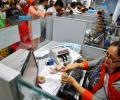
Led by the country's biggest lender State Bank of India (SBI), public sector banks logged a record cumulative profit of Rs 52,603 crore in the third quarter of the current fiscal, reflecting an 18 per cent year-on-year growth.

The Central Board of Secondary Education (CBSE) announced that nearly 40,000 students have successfully applied for verification and re-evaluation of Class 12 board exam answer books, despite the portal facing cyberattacks, including a denial-of-service attempt.

Uttar Pradesh DGP Rajeev Krishna announced a conviction rate of over 93 per cent due to the state's 'zero tolerance' policy against crime. Authorities seized properties worth nearly Rs 788.38 crore linked to criminal activities.

The Reserve Bank of India (RBI) Governor Sanjay Malhotra is now confronting the classic growth-inflation tradeoff, a situation exacerbated by the West Asia war, which threatens to end the 'goldilocks period' of low inflation and robust growth.

Investors are moving away from the commercial paper (CP) market towards certificates of deposit (CDs), as primary CD issuances and rates on these short-term instruments rise.

India's new manufacturing project announcements more than halved in the fourth quarter of FY26, falling 60 per cent sequentially and 78 per cent year-on-year to approximately 1.7 trillion, driven by global uncertainties, geopolitical conflicts in West Asia, and existing unutilised manufacturing capacity.

Yuzvendra Chahal's impressive bowling performance and Yash Dhull's explosive batting were among the highlights of the opening day of the DY Patil T20 Cup.

Batting for further consolidation in public sector banking, the executives of top public sector banks (PSBs) said there should be at least two Indian banking entities among the top 20 global banks.

Revenue collection next financial year may be affected, and, along with this, subsidies on food and fertilisers can go up if the war in West Asia drags for long, according to experts.

'I cannot imagine that any NSA before Ajit Doval would have given us this kind of time and this kind of engagement. They would have offered slogans, or nothing at all. That, too, tells you something.'
Public-sector banks (PSBs) are attracting the attention of investors and the PSU Bank Index has gained nearly 10 per cent in the past month. PSBs have seen return on assets (RoA) climbing to 1 per cent in 2024-2025 (FY25) and margins are believed to have moved up further in the first half of this financial year (H1FY26) with asset quality remaining stable.

With rising credit demand, cleaner balance sheets, and renewed investor confidence, banks are positioned at the forefront of the market rally. From major players like ICICI and HDFC to broader policy shifts, there's much driving this momentum.
With rising credit demand, cleaner balance sheets, and renewed investor confidence, banks are positioned at the forefront of the market rally. From major players like ICICI and HDFC to broader policy shifts, there's much driving this momentum.
With rising credit demand, cleaner balance sheets, and renewed investor confidence, banks are positioned at the forefront of the market rally. From major players like ICICI and HDFC to broader policy shifts, there's much driving this momentum.

Home purchase affordability has improved in the first half of calendar year (CY) 2025, after the RBI reduced the repo rate by 100 basis points (bps), according to real estate consultancy Knight Frank India.

Nitish Reddy fails with bat as Vidarbha take first-innings lead against Andhra

'Rate cut looks unlikely and there is reason to believe that the cycle is over.'

The Indian economy is likely to grow at 7.4 per cent in 2025-26, up from 6.5 per cent in the previous fiscal, mainly on account of better performance of manufacturing and services sectors, as per the government data released on Wednesday.

Bank of Baroda Q4 results: Key brokerages have raised their target prices on Bank of Baroda after the state-owned lender posted better-than-expected March quarter (Q4FY23) results. Analysts now see up to 29 per cent upside in the stock from a one-year perspective as they believe BoB is well-placed among the large public banks with nearly all key business metrics moving closer to the top-tier banks. Valuations, too, remain attractive despite steady strong quarterly performances.

The more things change, the more they remain the same for corporate India. In the April-June 2025 period (Q1FY26) - for the ninth consecutive quarter - listed companies witnessed only single-digit revenue growth, while their core earnings, excluding other income and one-time gains, contracted for the second time in four quarters. This comes as firms brace for the impact of 50 per cent US tariff on Indian goods.

Banking stocks led by SBI, ICICI Bank, Bank of Baroda, PNB, Kotak Bank, HDFC Bank, Axis Bank, Federal Bank and Yes Bank fell as much as 2.77 per cent.

The broader NSE Nifty reclaimed the key 10,000-mark and touched a high of 10,143.50 before finally settling at 10,130.65
The RBI is likely to reduce the key interest rate by 25 basis points this week after keeping it on hold for two years, complementing the Union Budget initiatives to push consumption-led demand, though the sliding rupee continues to be a concern. As the retail inflation has remained within the Reserve Bank's comfort zone (less than 6 per cent) for most of the year, the central bank can take rate action to boost growth hit by sluggish consumption, opined experts.
Private sector lender ICICI Bank has revised its external benchmark lending rate (EBLR) to 8.10 per cent, and state-owned Bank of Baroda has raised the rate to 6.90 per cent with immediate effect after the RBI hiked the key repo rate. Likewise, two other public sector banks -- Bank of India and Central Bank of India -- have also raised the repo linked lending rate. In an out of turn Monetary Committee Meeting (MPC), the Reserve Bank on Wednesday announced to hike the benchmark repo rate -- the short term lending rate it charges to banks -- by 0.40 per cent to 4.40 per cent with immediate effect, aimed at taming the rising inflation caused by the global geopolitical situation.

Retail inflation dipped marginally to a nearly six-year low of 3.34 per cent in March due to a decline in prices of vegetables and protein-rich items. The Consumer Price Index (CPI) based inflation was 3.61 per cent in February and 4.85 per cent in March last year.

Quarterly earnings from corporates, global trends, and trading activity of foreign investors will guide market sentiment this week, analysts said, adding that benchmark indices may face volatile trends. "The upcoming release of Q2 results will be closely watched, providing insights into corporate performance. "Meanwhile, the escalating tensions between Israel and Iran introduce a significant geopolitical risk, potentially leading to increased oil prices and market volatility.

In response to the panic triggered by Trump's trade policies, the RBI net sold approximately $43 billion in the second half of FY25 to curb volatility, as the rupee plunged to a low of 87.95 per dollar in February this year.

The US Fed interest rate decision, ongoing quarterly earnings, macroeconomic data and FII trading activity are the major triggers that will drive stock markets this week, analysts said. Investors would also track global market trends and the movement in global oil prices for further cues. "This week, the focus will shift to global cues, particularly the US markets," Santosh Meena, Head of Research, Swastika Investmart Ltd said.

'Challenge is basically near-term growth as the outlook has turned a bit adverse.'

A day after the Reserve Bank of India's (RBI's) Monetary Policy Committee hiked the policy repo rate by 50 basis points (bps), several commercial banks, including ICICI Bank and Bank of Baroda, raised their external benchmark-linked loan rates by an equal amount on Thursday. HDFC, the country's largest mortgage lender, too, increased its interest rates on housing loans by another 50 bps. In total, it has raised rates by 85 bps since May 4, when the RBI had increased the repo rate by 40 bps in an off-cycle meeting.

Not all public sector banks are back in the black, but their collective net profit for the year is Rs 32,346 crore against a Rs 9,013 crore loss in the previous year, points out Tamal Bandyopadhyay.

Days after the US Fed raised the interest rate, the RBI may go in for its third consecutive policy rate hike by at least 35 basis points to check high retail inflation, experts said. The central bank has already announced to gradually withdraw its accommodative monetary policy stance. The Reserve Bank of India's rate-setting panel -- the Monetary Policy Committee -- will meet for three days from August 3 to deliberate on the prevailing economic situation and announce its bi-monthly review on Friday.

More than 50 per cent of SIP accounts come from semi-urban and rural areas.

'The expeditious enactment of labour codes and strategic measures to bridge the skills jobs gap are critical.'
